
How a Digital Signage Manufacturer Helps Brands Create Smarter Customer Experiences
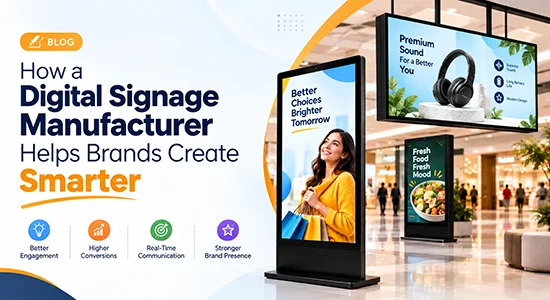
Modern customers move quickly through stores, offices, hotels, hospitals, campuses and public spaces. Static information still has a role, but brands increasingly need displays that can change with promotions, schedules, navigation needs and audience behaviour. That is where a capable Digital signage manufacturer becomes valuable: the job is not simply to supply a screen, but to build a complete communication system around the space, content and business objective.
For businesses evaluating a long-term display partner, Vivida Displays presents digital and static display solutions for retail, healthcare, hospitality, education, corporate and other environments. Its website describes in-house manufacturing, custom display capability, installation and after-sales support, making it relevant for projects that require more than a standard off-the-shelf sign.
What a Digital Signage Manufacturer Actually Does
A professional manufacturer looks at the entire display journey: site conditions, viewing distance, ambient light, content format, mounting method, power and data availability, user access, maintenance and future expansion. This prevents a common mistake—choosing hardware first and discovering later that it is difficult to install, difficult to manage or poorly matched to the audience.
For retail, a digital signage system may need promotional loops, product launches and price communication. In hospitality it may support welcome messaging, event schedules and directional information. Corporate offices can use displays for internal communication, dashboards and visitor information. The correct solution depends on how people move through the environment and what they need to understand at each point.
Why Manufacturing Capability Matters
When design, fabrication and quality checks are coordinated, the final installation can be more consistent. Enclosures, frames, mounts, branded fascia and static signage often need to work together with digital displays. A manufacturer with in-house production can coordinate these elements instead of treating every part as an unrelated purchase.
It also becomes easier to customize dimensions, finishes and visual details. Brand environments rarely have perfectly standard spaces. Pillars, narrow corridors, large atriums, shopfronts and reception zones all create different constraints. Custom manufacturing helps the display look intentional rather than added as an afterthought.
Connecting Digital Signage With Other Display Systems
Digital signage works best when it supports a broader visual communication plan. Large-format LED can create high-impact focal points, while premium static signage handles permanent identification. Wayfinding systems reduce confusion, and retail display structures bring products into the same branded environment.
This mix is especially useful in malls, hospitals, universities, airports, hotels and multi-floor corporate buildings, where one medium cannot solve every communication need. The strongest projects use the right display type for each message instead of forcing every message onto a screen.
Questions to Ask Before Selecting a Supplier
Ask who is responsible for site survey, design, manufacturing, installation and training. Clarify how content will be updated, whether remote management is required, what happens during a hardware fault and how future additions will be handled. Also ask how brightness, resolution and viewing distance are determined for the installation.
A transparent process makes budgeting easier because it reduces surprise costs after purchase. The objective should be a system that staff can operate confidently and that visitors can understand instantly.
How These Solutions Connect
A signage project rarely depends on one product alone. Depending on the site, the specification may combine LED wall and LED screens, way finding system, premium signages and Vivida Displays. Coordinating these elements under one visual plan helps preserve hierarchy, brand consistency and practical navigation.
A Practical Project Checklist
- Define the business objective before choosing materials or technology.
- Record viewing distance, lighting, power, mounting surface and environmental conditions during the site survey.
- Use approved brand artwork and verify colors, dimensions and visibility before production.
- Clarify who handles design, manufacturing, logistics, installation, testing and future maintenance.
- Plan access for cleaning, repairs, graphic replacement or hardware service so the installation remains practical over time.
Frequently Asked Questions
What is the difference between a digital signage manufacturer and a dealer?
A dealer may primarily resell equipment, while a manufacturer can also design, fabricate, customize and coordinate physical display components. The exact scope varies by company, so buyers should confirm what is handled in-house.
Can digital signage be combined with static signboards?
Yes. Static identification, wayfinding and branded signboards can complement dynamic screens and reduce the need to use digital displays for permanent information.
Which industries use digital signage?
Retail, hospitality, healthcare, education, corporate offices, transport hubs, entertainment spaces and many other sectors use digital signage for communication, promotion and navigation.
Conclusion
Digital Signage Manufacturer is best approached as part of a complete communication system rather than as an isolated product purchase. Clear objectives, correct site information, suitable materials and professional installation all influence long-term performance. Buyers should compare suppliers on process, customization, execution and support—not only on the initial quoted price.
For product details and related signage solutions, visit Vivida Displays.